Transform the traveler experience, personalize services, and optimize operations with the help of an eCommerce platform.
Understanding your traveler is not just a competitive advantage, it's a necessity. User experience has become the heart of the industry, and every interaction counts in building a lasting and satisfying relationship. However, how can we truly understand travelers' needs, wants, and behaviors?
The solution can be found in data analytics. With a large volume of information being generated at each step of the purchasing process, including destination research and post-trip reviews, there is a special opportunity to gain insights into and comprehend trends that can revolutionize the operations of bus companies.
But what types of data can be measured, how can it be analyzed, and how can the insights be applied to deliver personalized experiences to travelers? It might seem complex, or you might think you need more than one tool.
However, your eCommerce platform enables you to gain a better understanding of your travelers, their interests, and needs, and to have essential metrics at your fingertips when they make an online purchase for bus tickets.
eCommerce, the ally to know your traveler
An eCommerce platform offers significant advantages to a company, such as access to data at any time of the day. This eliminates the need for multiple employees working different shifts to handle bus ticket sales. With an eCommerce platform, travelers can purchase tickets at their convenience, and the bus company can analyze each stage of the purchasing process and make real-time adjustments if needed.
Availability and accessibility for travelers also make it possible, for example, to track user behavior on the website and learn about:
Sections of the site that are of interest to them.
Times they consult a route.
Dates and times they are most interested in.
In the last edition of Reservamos On-Road Talks, Alexandier Meza, general manager of Roll&Bits, shared that thanks to the eCommerce platform developed by Reservamos SaaS they have been able to know which transportation service (bus or van) is more attractive to their travelers.
Data analysis becomes essential to know our travelers better. Through data, a purchase history is generated where, without logging in or registering in eCommerce, we can group users according to their behavior. In the purchase process, they complete data that are essential for us. By cross-referencing this information, we can identify our travelers even if they have not registered. This can help us with future strategies and increase loyalty. - Alexandier Meza, general manager of Roll&Bits.
That's why this digital sales channel helps to have greater operational efficiency, reduce costs, and improve the shopping experience, by knowing what they prefer when purchasing a ticket online.
Personalized shopping experiences
According to Alexandier, the focus should be on analyzing traveler data. Understanding what the user is looking for allows companies to generate personalized shopping experiences.
We need to provide personalized services. Travelers are eager for the services we offer to be more tailored to their individual needs. They don't want to be addressed in general terms; they want to be addressed personally, as Alexandier. Achieving this level of personalization is extremely important, and it can only be accomplished through digitalization. - Alexandier Meza, General Manager of Roll&Bits.
You can even offer a hyper-personalized and AI-driven shopping experience. This is possible thanks to the AI-powered search widget, which allows the user to be given suggestions on the routes they are looking for the most or the last ones they have searched for.
How is the search widget working? This is one of the innovations and updates offered by Reservamos SaaS eCommerce technology. It works through artificial intelligence, assigning an anonymous identifier to that user.
That identifier assigns an anonymous name to a user, for example, anonymous 99 or anonymous 100. When that user logs back into the bus company's eCommerce, the bus company remembers who the user is who did the search and makes suggestions based on that search history.
We have observed that this technique addresses the conversion and agility issues when making a purchase. By eliminating the need to enter your origin-destination, it is presented as a suggestion instead. The user selects the date, completes the payment, chooses a seat, and that's all. This optimizes the flow of the process. - Alexandier Meza, general manager of Roll&Bits.
Obtaining this knowledge of the traveler, based on data analysis, does not necessarily represent a high percentage of investment. The most viable option is to have a technological partner with these solutions. Alexandier considers that the advantage of having an ally such as Reservamos SaaS invests eCommerce low.
We know that as mobility transportation companies we have a hard time with technology because the investments are usually very high. We have to spend on a technology team to develop eCommerce, mobile applications, or fleet management systems. Having a partner like Reservamos SaaS that has developed these solutions is very positive. -Alexandier Meza, general manager of Roll&Bits.
Future of eCommerce in the bus industry
Data analytics has become essential for gaining a deep understanding of travelers' preferences and behaviors. The implementation of technology in bus companies' eCommerce not only allows them to optimize the availability and accessibility of services but also enables the ability to collect and analyze information, which can be used to deliver highly personalized shopping experiences.
The future of eCommerce in the travel sector holds tremendous potential for advancements driven by artificial intelligence and hyper-personalization. Tools like search widgets and recommendation algorithms are proving their value by enhancing the user experience and boosting conversion rates and completed purchases. The capability to predict and anticipate traveler needs will empower companies to not only meet but also exceed the expectations of their users.
eCommerce represents not only a transformation in the way bus tickets are sold but also an integral evolution in the relationship with the traveler. By leveraging the capabilities of data analytics and artificial intelligence, companies can create unique and more satisfying experiences, ensuring a sustainable competitive advantage in the travel market.
Learn about the adoption of advanced technologies and how bus companies can leverage these changes to deliver a better traveler experience, increase revenue, and stay competitive in an ever-evolving industry.
When discussing technological innovation trends in the bus sector in Latin America, the first thing that stands out is the investment in new buses to replace their fleets. This includes opting for buses that are more environmentally friendly and fuel-efficient.
According to Statista, with growing concern about climate change and air pollution, travelers are increasingly looking for buses with lower emissions and better fuel economy.
This has led to increased demand for electric and hybrid buses. In addition, customers are also looking for buses that offer more comfort and amenities, such as air conditioning, Wi-Fi connectivity, and ergonomic seats.
This trend, according to Statista, is particularly evident in countries with large metropolitan areas, such as Brazil and Mexico. Another trend in the market is the adoption of smart technologies in buses. This includes features such as GPS tracking, real-time passenger information systems, and contactless payment options.
However, technological innovation in the sector has focused, for now, on the offline side by renewing fleets and choosing innovative technologies for bus operations.
The online side of the industry still has a long way to go to offer a completely innovative experience that involves offering travelers a ticket purchase without the need to go to the ticket office culminating in a bus ride that offers the best amenities.
Digital transformation landscape in the bus sector
Approximately only 15% of Latin American companies (enterprises) have developed their technology for eCommerce and revenue management, so costs and implementation times tend to be higher in terms of technology acquisition and longer implementation times.
The rest (small and medium-sized companies) work with white labels of online travel agencies (OTAs), which has reduced their positioning and lack of data on their passengers to make better decisions in different areas (marketing, operations, finance, SAC), according to an analysis conducted by Reservamos SaaS.
Based on our analysis, the most used technological tools by bus companies in the region, 90%, are only Google Analytics, Facebook Pixel, or Tag Manager.
Less than 1% use tools such as Hotjar, a product experience insights platform that provides behavioral analysis and feedback data to help empathize and understand customers, or more advanced tools to know the behavior of each of your travelers, where in the process they leave your website, what is the recurrence of purchase of a person.
There is low adoption of technology and a low percentage allocated to investment in this type of technological tool or solution. Less than 0.5% of the total revenue of bus companies is allocated to IT.
On the contrary, in the airline sector, the budget allocated to IT service management has gained ground. In 2022 the increase was noticeable, due to spending that reached 4.73% of revenue, compared to the 4.66% recorded in 2021, according to the 2023 Air Transport IT Insights report, conducted by the multinational company SITA.
Airline investment priorities have focused on improving mobile passenger services, strengthening cybersecurity, and enhancing cloud services capabilities.
According to the report, airlines are also betting on data management for business intelligence, data exchange technologies, Artificial Intelligence, and radio frequency identification and tracking of baggage (RFID).
Against this backdrop, how can bus companies join the digitization of their ticketing channels? Below we share with you the route they could follow to avoid losing the opportunity to take control of their sales and increase their revenues.
How bus companies can go digital
In order not to be left out of the digitalization process, bus companies have the option of adding a technological partner that has the expertise to help them take control of direct ticket sales.
For example, Reservamos SaaS works as a technological ally that helps to evolve the digital sale of tickets, through a dynamic, efficient, and customizable platform for any brand and needs.
The Reservamos SaaS eCommerce platform helps bus companies enhance their digital channels, boost sales, and cut costs. It offers a robust analytics tool for understanding traveler behavior through data.
The data is 100% owned by the bus company, with 24/7 access. In addition to having different payment gateway options, adapted to the most popular in each country, and ticket distributors.
The eCommerce platform of a technology partner like Reservamos SaaS aims to ensure better digital shopping experiences. Especially in a context where consumers have become accustomed to the convenience and speed of online shopping, bus companies have had to adapt quickly to meet these new demands.
It is almost impossible to survive in a scenario without digitization. The decision to change does not come from the companies but from the customers. We decided that we love to have everything on the screen of our smartphones and computers. No turning back. -Thiego Paes, Country Manager for Brazil at Reservamos SaaS.
This transformation has been driven by several factors, such as the increased use of mobile devices, Internet penetration in urban and rural areas, and the need to offer more secure and efficient purchasing solutions in a post-pandemic world.
Online ticketing not only facilitates the purchasing process for passengers but also provides companies with valuable opportunities to collect data and personalize their services.
In some countries in Europe and North America, it is estimated that between 30% and 70% of bus tickets are sold online. In emerging markets, this percentage may be lower, but it is growing steadily.
In Brazil, one of the largest markets, it is estimated that between 40% and 50% of bus tickets are sold through OTAs. While in the direct channel, sales represent 10-15% on average.
Revenues in the bus ticket market in Latin America are expected to reach US$3.36 billion by the end of 2024, according to Statista.
Revenues are expected to show a 2.37% annual growth rate, resulting in a projected market volume of US$3.69 billion by 2028. As for the number of users, it is projected to reach 60.31 million by the same year, according to Statista.
Of the total bus ticket market revenue, 56% is going to be generated through online sales by 2028. Therefore, the digital channel will become increasingly important for bus companies' revenues in the region.
However, it is important to consider that an eCommerce platform is the gateway for a digitalization process in a bus company.
Digitalization is not having an eCommerce site, but a set of data management, personalization technology for customers, offering the best prices for the right customers, analyzing the market for decision-making, and simplifying the customer's buying process. -Thiego Paes, Country Manager for Brazil at Reservamos SaaS.
According to Thiego, an eCommerce site is the easiest and initial step to start the digitalization and customer service process. He believes that digitalization will allow bus companies to achieve 3 milestones:
Take care of the customer and offer the best product for travelers.
Knowing the customer and understanding how the product can help them simple and objective way.
Taking care of the business to offer the best service, at the best price (not the cheapest, but at the price that the traveler needs as a value proposition) and with more efficient and simple processes that allow generating more value for travelers.
The digital transformation process is complex and requires significant investment. Additionally, experts in this field are increasingly hard to come by in the market. Finding a business partner who is a technology expert with relevant experience can greatly expedite the transformation process and add significant value. -Thiego Paes, Country Manager for Brazil at Reservamos SaaS.
How to leverage data to improve the traveler experience
Leveraging data to improve the traveler experience is essential in today's digital world. Bus companies can use information gathered from various sources, such as the online direct ticketing channel, to offer more personalized, efficient, and satisfying services.
On the part of travelers, a trend is beginning to prefer to buy in the direct channel because it generates greater trust and the benefits that companies provide for their loyalty to their brands. This is a trend in the hotel industry, where one major player, Marriott, has seen membership in its loyalty program grow by a third in three years, and after executives touted the loyalty program as a cost-effective way to acquire customers.
Last year, Marriott reported record direct bookings. Direct bookings allow hotels to avoid the 10% to 30% commissions that online travel agencies charge, according to Skift.
Here's how you can leverage traveler data to drive direct ticket sales:
1. Personalizing the traveler experience
Use data to better understand your passengers' preferences and behaviors. With this information, you can personalize offers and recommendations, such as suggesting frequently used routes, offering preferred seating, and sending relevant promotions.
2. Price optimization
Analyze purchase data and demand to dynamically adjust prices. This not only maximizes revenue but also ensures that passengers find attractive pricing options based on their needs and shopping times.
3. Improved customer service
Data can help identify common problems and areas for improvement in customer service. With this information, you can implement proactive solutions, better train your staff, and offer more efficient and friendly service.
4. Loyalty programs
Create and adjust loyalty programs based on purchase and behavioral data analysis. Reward frequent travelers with points, discounts, and other benefits that they truly value, thus incentivizing loyalty and direct bookings.
5. Marketing segmentation
Segment your customer database to send targeted communications and offers to different groups. This allows for more effective marketing campaigns, ensuring that messages reach the right audience at the right time.
6. Improved route and schedule management
Analyze travel patterns to optimize your bus routes and schedules. This not only improves operational efficiency but also ensures that you are offering options that fit the needs of your passengers.
7. Simplified shopping experience
Use data to simplify the booking and purchasing process. Implement features such as auto-fill information, recommendations based on past purchases, and preferred payment options to make the process faster and more convenient.
8. Feedback and surveys
Collect and analyze passenger feedback to better understand their needs and expectations. Satisfaction surveys and comments can provide valuable insights on how to improve the traveler's experience at different stages of the journey.
The current state of online ticketing in the bus sector in Latin America reveals both significant challenges and opportunities. While companies have begun to invest in more modern and greener fleets, true digital transformation is still in its early stages. The adoption of advanced technologies for sales management and customer service personalization remains limited.
The evolution to a more digital sales model is not only about having an online presence but also about integrating analytics and data management tools to enhance the traveler experience and optimize operations. Companies that leverage these technologies will be able to offer more personalized and efficient services, increase customer satisfaction, and ultimately increase revenue.
The online bus ticketing market is experiencing significant growth, and there are positive projections for the future. However, to take advantage of these opportunities, companies need to invest in strong technology platforms and strategic partnerships. These investments will not only improve the booking experience but also provide valuable data for making informed and strategic decisions.
Digitization of the ticketing channel is not just a trend, but an urgent necessity for bus companies in Latin America. Those who adopt these technologies will be better positioned to meet the demands of travelers and remain competitive in a constantly evolving market.
We analyze the value of direct booking, assessing its impacts on operational efficiency, traveler satisfaction, and business profitability for bus companies.
In the digital age, the bus transportation sector faces a crossroads in its sales strategy: should companies focus on encouraging direct bookings or rely on ticketing agencies? This dilemma is crucial, as each method presents unique advantages and particular challenges.
Direct booking allows bus companies to control the traveler's experience, from ticket purchase to after-sales service, while maximizing their profit margins by avoiding third-party commissions.
On the other hand, ticketing agencies offer a consolidated platform with broad visibility and access to a diverse audience. In this article, we will explore the value of each approach, analyzing their impacts on operational efficiency, traveler satisfaction, and business profitability.
Value of direct booking when buying a bus ticket
When we discuss the primary value of direct booking, versus travel agencies, the benefits of passengers and bus companies must be considered. To do this, we will break down how each benefits from direct booking when purchasing bus tickets.
According to José Luis Landaeta, Head of Customer Success at Reservamos SaaS, the value for the bus companies and the traveler is as follows.
For bus companies
Cost reduction: they save costs by not paying commissions to OTAs, and they can also increase the margin of each transaction with actions such as round-ticket sales.
Data: data collection remains within the brand, i.e., they can access and consult any information needed at that moment and not depend on a third party to send you information that may be filtered in a certain way.
Liquidity: to have their income directly and not depend on the OTAs to send them the sales according to their policies. In their direct channels, the money goes directly to their bank accounts.
Experience: the brand knows and knows all the traveler's behavior within its own online sales channel, and even in other channels, such as the ticket office, which allows it to offer an experience that meets its service standards.
For the traveler
Price: direct sales have the best price because the traveler can save money. By buying directly on the site, you avoid commissions and markup (additional fees) that OTAs usually charge.
Promotions: you may find promotions that are only available on brand pages. For example, some brands send anniversary promotions exclusively on their direct channels.
Booking or purchase management: consumers have a better experience in direct channels since they have more customization in routes, preferred schedules, and seat selection. In addition, customer service is simpler when it comes to a purchase within the direct channel. Changes and cancellations are easier to process since they are in direct contact with the brand.
Loyalty: when buying directly with the brand, they have access to loyalty programs that generate benefits not found in other channels.
Regarding the management of revenue from the sale of bus tickets in agency versus direct channel, the main difference is that in direct sales the revenue falls directly to the brand's accounts.
With this, the companies have the daily settlement of sales, so they can have their financial strategy adequate to their cash flow, plus the profit margins are higher because they avoid paying the high commissions that OTAs have.
Advantages and disadvantages for a company that markets its digital ticketing through an OTA
In the digital age, selling bus tickets through online travel agencies (OTAs) has gained significant popularity, offering both advantages and disadvantages for bus companies. On the one hand, OTAs provide an established platform with a wide audience and global reach, which can result in an immediate increase in sales and visibility.
However, relying on OTAs can also imply several challenges, such as reduced profit margins due to commissions; loss of control over the direct relationship with the traveler; potential conflicts in price management and promotions; and above all, one of the most important, limited access to data on traveler behavior, which hinders the possibility of converting that advantage into strategies that drive growth, such as the creation of new functionalities or updates to eCommerce, in line with market trends, the traveler and new technologies.
Based on the experience and knowledge of the Customer Success area of Reservamos SaaS, led by José Luis, we share with you the advantages and disadvantages for a bus company marketing its digital tickets through an online travel agency, offering a comprehensive vision for companies to make informed decisions about their sales strategies.
Advantages
Disadvantages
Audience access. Participating in an additional distribution channel has greater reach, all OTAs have traffic that can help you reach more travelers.
Costs and commissions. OTAs often charge high commission percentages, which can affect the company's margins.
Advertising. OTAs have a high marketing spend (usually), which can help the brand become known or strengthen its position in the market.
Financial dependence. A high dependence on sales through OTAs can result in a significant part of your revenue being subject to these commercial conditions (payment terms).
Comparison. In OTAs, travelers can easily compare which is the best option, so sometimes they can help the brand that is better positioned in terms of price and departure options.
Competition. The competitive nature of OTAs can result in a price war, seeing all the brands together and looking for the same goal of having the best price, unleashing this war.
Synergies. With OTAs, it is possible to create packages that can benefit the brand by offering transfer + hotel or other services.
Loyalty. It is difficult to generate loyalty to your brand with so many options shown. The traveler only generates loyalty to the OTA or to whoever has the lowest price and not to your brand.
Limited personalization. The brand loses control of how information is presented and the traveler's shopping experience.
Low rates of innovation. Leaving the management of your eCommerce to an OTA or keeping only the presence in this external channel results in a technological slowdown for your company and a competitive disadvantage in your market.
Role of promotions and offers in the choice between direct booking and travel agencies
According to José Luis, if in the direct channel bus companies have a differentiated (better) price and also offer an adequate shopping experience with excellent after-sales service, the balance is increasingly tipping towards direct purchase where the traveler has 3 important aspects in his favor: price, experience and control of his booking.
Promotions and special offers can influence the traveler's perception of value, making one option more attractive than the other, based on the additional benefits offered. In addition to value, travelers can review where they have the best experience, control of their booking, and after-sales service to make the purchase. - José Luis Landaeta, Head of Customer Success at Reservamos Saas.
What steps should bus companies take to promote direct bookings?
In order for bus companies to optimize their sales and strengthen their relationship with their travelers, it is crucial that they implement a number of strategies focused on direct bookings.
Implementing these strategies not only optimizes direct sales but also improves the traveler experience and strengthens the competitive position of bus companies in the market.
José Luis shares some essential actions that all companies should be taking.
Dynamic pricing: Provide exclusive pricing for direct bookings, incentivize advance purchases through a pricing strategy, activate discount codes in special seasons, and adjust prices in real-time based on demand and other market factors.
Additional benefits: Include additional benefits for direct bookings, such as priority boarding, and preferential seating for direct channels only.
Loyalty programs: Implement loyalty programs that reward travelers for direct bookings by accumulating points that can be redeemed for future discounts or additional services. This increases retention rates and the base of loyal travelers.
Digital marketing campaigns: Use digital marketing to drive traffic to the official website, including social media advertising, SEO, SEM, and email marketing campaigns.
User education: Communicate to travelers the benefits of booking directly, such as lower prices, exclusive offers, and better customer service.
Retargeting:Implement retargeting strategies to engage travelers who visited the website but did not complete a booking or abandoned the shopping cart.
Price transparency: Communicate final prices clearly and transparently, emphasizing that direct sales avoid surprise charges.
Competitive pricing: Ensure that prices in the direct channel are competitive with those offered by OTAs (at least 10% lower in the direct channel).
Exclusive offers: Create exclusive offers and packages available only through direct booking.
Data analytics: Use data on traveler behavior in the direct channel to better understand traveler preferences, develop personalized marketing strategies, and improve the traveler experience.
Feedback and improvements: Collect feedback from travelers on their direct booking experience and use it to make continuous service improvements.
It is important to recapitulate the importance of having control of the direct channel when selling bus tickets online. Especially with the help of specialized technology such as that offered by Reservamos SaaS, because in this way, companies will be able to offer greater personalization to travelers about routes, preferred schedules, and seat selection, i.e., the components of the search.
Here is a summary of the main advantages of personalization:
Improved user experience: Having control over the sales platform allows the company to continuously improve the user interface and experience, making it easier to navigate, book and manage trips.
New product development: With direct access to customer data, companies can identify emerging trends and demands, enabling them to develop new products and services that better meet their customers' needs.
Rapid testing and adjustment: Direct selling allows companies to test new offerings and adjust them quickly based on customer feedback, accelerating the innovation cycle.
Exclusive promotions: By selling directly, companies can offer exclusive promotions and discounts to their customers, incentivizing direct bookings and building a loyal customer base.
Personalized promotions: Companies can create customized promotions and discounts for different customer segments, optimizing revenue and customer satisfaction.
Digital marketing: With direct access to customer data, companies can develop more effective digital marketing campaigns, using advanced segmentation and targeting techniques.
Differentiation from the competition: By innovating in their own sales channel, companies can differentiate themselves from the competition through unique features and a clear value proposition.
Through the direct channel, companies can also take control and make decisions for constant innovation in terms of improving their eCommerce and data usage.
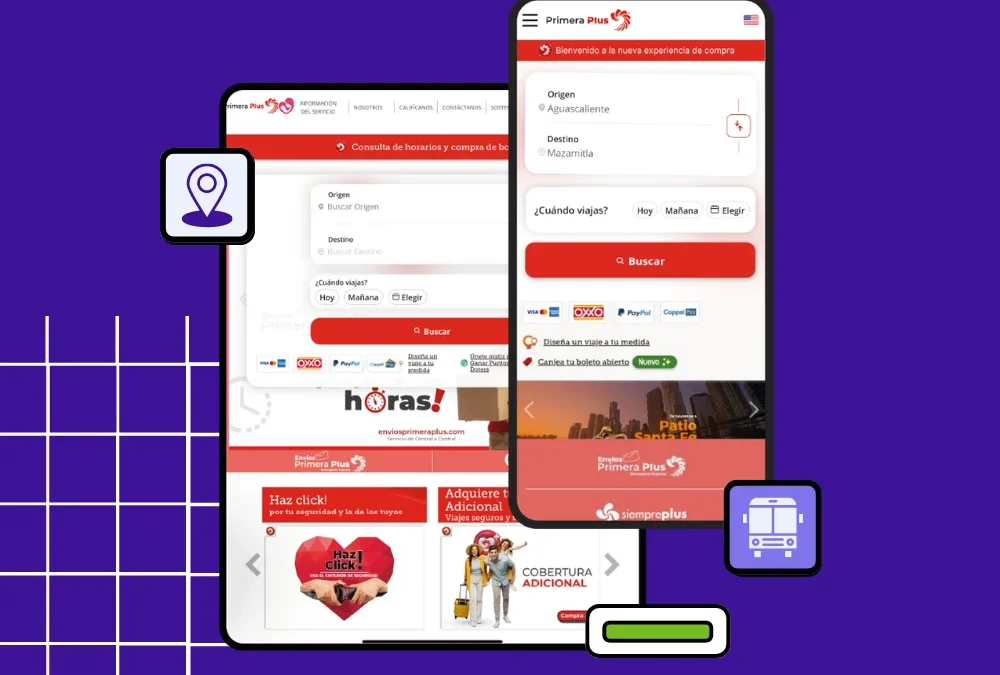
At Reservamos SaaS we maintain a constant pace of innovation in the solutions that make up our technology ecosystem. For example, our Product Designer team completely revamped the search system in our partners' eCommerce, which benefited bus companies that use this service by prioritizing their direct sales channel.
In another case, by having control of the data through the direct channel, is that Marketing Automation strategies can be generated with the help of solutions such as ReservamosONE, an intelligent system that unifies a user's interactions with the different sales channels (online and offline), to create personalized pricing and marketing strategies.
Companies that decide to sell tickets directly online can implement personalization strategies on their platforms, offering recommendations and promotions based on the customer's history and preferences.
We answer your questions about Revenue Management so that you can learn how to optimize your revenues and maximize profits in a competitive industry.
In such a competitive industry, revenue optimization is an undisputed priority for any business. In this context, Revenue Management emerges as a fundamental strategy to maximize profits and ensure financial sustainability.
However, this concept may be unfamiliar or confusing for many. That is why this text aims to address the most frequently asked questions about Revenue Management, offering a clear and concise overview of its fundamentals, applications, and benefits.
For this, Camilla Brugali, Revenue Management Product Manager for Reservamos SaaS, answers the most frequently asked questions, from basic definitions to a strategic vision of revenue management, explaining how this discipline can transform the bus sector and lead it to success in a dynamic and changing industry.
1. What is Revenue Management?
Revenue Management is a strategy that aims to maximize a company's total revenue.
Having a Revenue Management strategy consists of using your company's sales performance data, data from your main competitors, and other market variables to predict consumer demand by optimizing price.
Price optimization is based on dynamic pricing, which is predicted based on the predictability that data will provide from the customer's perception of the value and availability of the offer at a given time.
Revenue Management is the ideal practice, especially for industries that have a perishable product, high fluctuations in demand, products that consumers may want to buy in advance, and, mainly, competitors that charge lower prices than the market average (low-cost competitors).
Moreover, in the current market dynamics, where the same product is sold in several sales channels, whether physical points of sale, eCommerce, or OTAs Marketplaces, Revenue Management is the strategy that can help identify the right price for each sales channel and, with the support of technology, do it massively.
In short, Revenue Management can be summarized in the following phrase: sell the product or service at the right time, to the right customer, at the right price.
2. What is the main objective of Revenue Management in the bus sector?
The main objective of Revenue Management is always to maximize total revenue, considering factors such as demand, capacity, and costs.
Based on data capture and analysis, Revenue Management aims to anticipate customer behavior, adapt the prices of products or services, and manage availability to optimize revenue.
In other words, historical analyses of demand and profitability are expected to support decision-making strategically and massively, avoiding premises that do not take into account internal and external data.
3. How do they provide accurate and agile answers on market behavior to anticipate pricing and inventory strategy?
Technology plays a fundamental role. A Revenue Management system, such as Reservamos SaaS, allows massive and automated monitoring of what competitors are doing and the company's sales performance. With the data collected, the Revenue Management system allows visualization of indicators and metrics of the company and its competitors.
The simplified visualization of data in one place allows the company to act assertively and nimbly, based on accurate information.
On the other hand, technology can help even more. The Revenue Management system, through technologies such as Artificial Intelligence and machine learning, learns from the data. That is, the system can support you with alerts and suggestions for price changes so that the company does not miss any opportunity.
4. Can lowering or raising prices represent a loss for bus companies?
No. The Revenue Management strategy consists of working with dynamic pricing (raising prices or lowering prices). This pricing flexibility is based on supply and demand for a given product or service. In other words, increasing prices when demand increases and reducing prices when demand is low.
Price variation is the basis for understanding the customer's perception of value and propensity to buy. Let's not forget that different people are willing to pay different prices for the same product; that is where the opportunity lies.
Every price change suggested by the Revenue Management practice takes into account the main objective: to maximize total revenue. In other words, lowering a price at a given moment does not represent a loss, since it is an isolated event within a broader pricing strategy, with price decreases and increases.
For example, dynamic pricing, for a product that can be purchased in advance, is a great opportunity to attract new customers and generate a sense of urgency to complete the purchase.
5. How does Revenue Management help to give the right price for a bus ticket?
The Revenue Management strategy helps by suggesting the best price for a given customer at a given time. This price is set based on current demand and market conditions.
With this, we can understand that the right price is given considering a deep analysis of historical data and real-time competitor data.
6. Does a bus company require a specialized team in Revenue Management for the implementation of the Revenue Management System?
A large or specialized team is not required to implement a Revenue Management system. However, it is necessary to have a person responsible for working on the system and who can act on prices.
To ensure the execution of a Revenue Management strategy, daily monitoring is necessary. Revenue management is a daily exercise. It is necessary to monitor the company's sales performance and the behavior of competitors, to find opportunities.
This can be done with the support of the Revenue Management System, which will do it automatically and alert on opportunities.
On the other hand, it will not work to implement a system without someone responsible for observing price change opportunities and acting accordingly. The person responsible for pricing in the company must have total autonomy for continuous price changes because that is the basis of Revenue Management practice.
7. Are there risks in implementing a dynamic pricing strategy in a bus company?
The success of Revenue Management is based on revenue maximization. Given this, there are no risks for a company when working with dynamic pricing, since prices in a Revenue Management practice are determined through historical data and market data. These are decisions based on data intelligence and predictive mathematics, it is a science.
8. What does the Revenue Management System solution consist of?
The Reservamos SaaS Revenue Management System consists of two modules: Competitor Monitor and Revenue Management.
The Competitor Monitor module allows companies to monitor and receive alerts on the price and occupancy behavior of their main competitors.
The Revenue Management module allows companies to set the optimal price for all their inventory and through all sales channels.
9. Is there any implementation required to adopt the Revenue Management System?
For the Revenue Management System to work we need to integrate it into your sales channels and inventory management system and be able to effectively change the price of the tickets, depending on the initial configuration. We guide our partners through the whole process and use of the tool.
For the Competitor Monitor module, there is no need for any integration, you simply need to inform the competitors you want to monitor.
For the Revenue Management module, integration is required, via API, with the company's inventory system and sales channels. In this way, the Revenue Management System will be able to modify prices automatically and monitor the results of each pricing strategy executed.
10. What is the best season to test the Revenue Management System to get better data and results?
Today is the best time to start working with the Revenue Management System. This system will help your company maximize revenue through dynamic pricing.
Whether in a period of high demand or not, Reservamos SaaS is ready to support your company in the implementation of the Revenue Management System.
Throughout this text, we have explored the most frequently asked questions about Revenue Management by addressing questions about implementation, benefits, and potential risks.
Also, it is important to reiterate the need for technological tools such as the Reservamos SaaS Revenue Management System, which facilitates informed decision-making and the effective execution of Revenue Management strategies.
In short, Revenue Management emerges as a useful tool for maximizing revenue and ensuring financial sustainability in an increasingly dynamic and demanding business world. Adopting this practice is not only an option but a necessity for companies that aspire to stand out and thrive in today's competitive landscape.
We tell you how the Reservamos SaaS Product Designer team works to redesign the search widget in the eCommerce of our partner bus companies, and how we measure its success.
At Reservamos SaaS we develop technology that drives the evolution of online sales channels for bus companies. This is to offer intelligent, personalized, and secure shopping experiences.
To provide these experiences it is necessary to be in constant search of a functional, intuitive, and personalized design. This is where our Product Designer team, made up of UX/UI design professionals, had a hand in completely revamping the search system on the eCommerce platform, focusing on user experience and technical efficiency.
Every aspect, from the interface to the enhanced functionalities, was meticulously redesigned to provide our partners' users with a faster, more intuitive, and personalized search experience.
An intuitive interface implies clear navigation and an attractive visual presentation that effectively guides the user to their goal. - Jair Pérez, Lead Product Designer at Reservamos SaaS.
A redesign based on data and analytics
The Product Designer team previously conducted a benchmark that involved analyzing the functionality, usability, and aesthetics of similar components from other companies, to identify best practices and trends in design and functionality.
This analysis was not only limited to travel sites but to any product that might have some functionality they were interested in at the time. This is a constant practice within the team, which reviews applications to detect if any component is interesting to apply in the bus sector. This is done to improve the quality of the design.
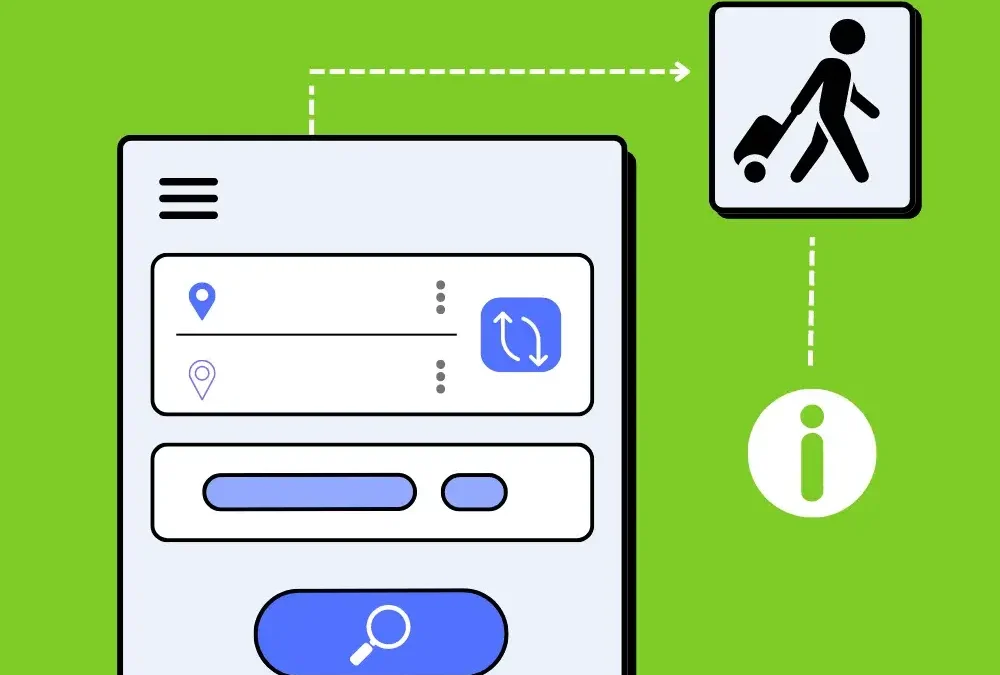
One of the most outstanding features of the search widget is the advanced customization of the widget. Now, the destination field suggests cities based on the user's origin, which streamlines the search process. In addition, it learns from the user's preferences to suggest anticipated routes, improving the efficiency and relevance of searches.
When we talk about an optimal personalized experience, we mean that the user makes the product his own and can interact with it more simply and effectively. - Jair Pérez, Lead Product Designer at Reservamos SaaS.
The redesign was not only limited to visuals, we also worked on code optimization to improve loading speed, implementation of caching technologies to reduce server response times, and responsive design practices to ensure a consistent experience on different devices and screen sizes.
Constant monitoring for success
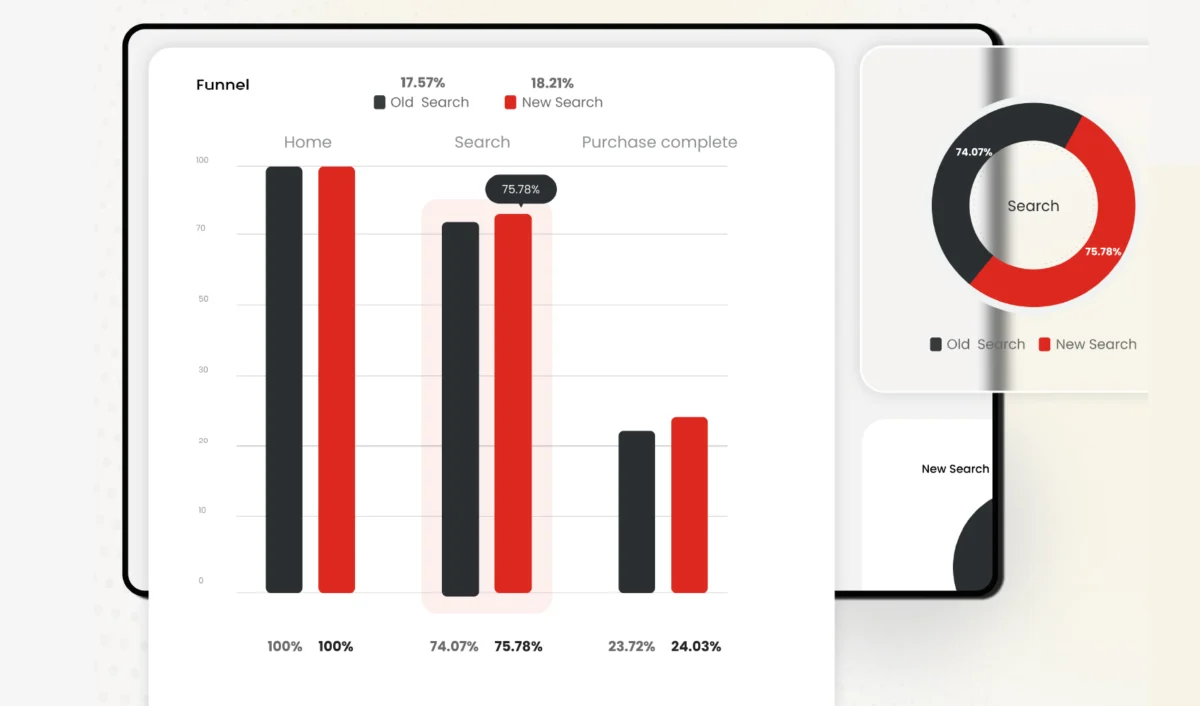
As part of the follow-up to the launch of the new search widget, the Product Designer team focused on measuring the average time it took the user to perform a search, user feedback, and analysis of browsing behavior to identify areas for improvement. This allowed for data-driven adjustments to continuously optimize the search experience and ensure a better experience with the bus company's eCommerce.
The metric to track is how long it takes a user to perform some task. In this case, how long it take the user to perform the search from the moment they enter the home page. - Jair Pérez, Lead Product Designer at Reservamos SaaS.
According to Jair, the personalization improvements they made helped them complete this task in less time. Now they know what route the user might be looking for to display that preloaded information, so the user only has to choose the day he/she is interested in traveling.
Leaving aside that each functionality has a specific objective, we could say that the main thing we are looking for is that the user can understand and interact with our design. - Jair Pérez, Lead Product Designer at Reservamos SaaS.
Part of the Product Designer team's job, before it goes into production, is to see what they expect from the new release and what metrics will tell them that their redesign is working. Once some time has passed, the product team analyzes that data to make corrections or terminate it. In addition, an important point is that they are always on the lookout for what users think of the product, through the survey they are shown at the end of an online purchase of a ticket.
Through this work methodology, the Product Designer team remains committed to continuous improvement, using key metrics on user behavior in our partners' eCommerce sites, and feedback from travelers, to identify areas of opportunity and make pertinent adjustments.
Our focus at Reservamos SaaS is to understand and adapt to the needs of travelers and bus companies, to maintain agile rates of innovation, and to offer solutions that simplify and enrich the online bus ticket purchasing experience, thus ensuring the digital success of our partners.