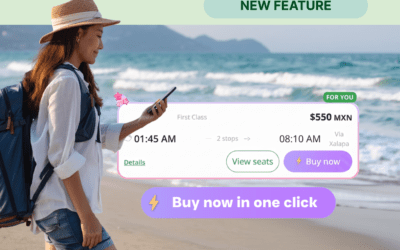


The digital experience is already part of the transportation service. Discover how bus companies can adapt to the New Passenger Experience.
For many years, transportation companies understood that their service began when passengers boarded a vehicle. The experience was measured by punctuality, travel comfort, or the quality of service during the journey. However, travelers' expectations have changed.
Today, the first interaction with a bus company takes place several steps before passengers arrive at a terminal: it begins when someone opens a website, searches for a route, and decides whether that process inspires enough confidence to continue.
The digital experience has evolved from being merely a sales channel into an extension of the transportation service itself. The ease of finding a trip, the speed at which available options are presented, and the clarity of the purchasing process all shape the perception passengers develop of a brand. In other words, the journey no longer begins when passengers board the bus; it begins with the very first search.
This transformation is not exclusive to ground transportation. In the tourism industry, leading companies have recognized that the discovery and booking experience has a direct impact on travelers' decisions.
A joint analysis by McKinsey & Company and Skift indicates that users seek platforms capable of simplifying discovery and booking through intuitive processes, relevant recommendations, and frictionless journeys because the quality of that experience directly influences their choice of provider.
The digital journey begins with a search
Most e-commerce optimization strategies focus on checkout, payment methods, or reducing cart abandonment. However, the purchase decision begins much earlier.
When travelers perform a search, they are already sharing valuable information. The origin they select, the destination they explore, the dates they compare, or even the searches they abandon all represent clear signals of their travel intent. These interactions make it possible to understand how they make decisions and identify where the greatest friction points arise during the purchasing process.
The real shift is that this information is no longer used solely to generate reports or analyze results at the end of the month. Today, it can be used in real time to create a simpler, more relevant, and more efficient experience from the very first click.
According to McKinsey, travelers may interact with dozens of digital touchpoints before completing a booking. Throughout that journey, they constantly switch between devices, compare alternatives, and expect every interaction to be consistent. Each of those moments influences the final purchase decision.
The search widget is the first moment of the experience
For years, an e-commerce search engine was viewed as a form whose sole purpose was to capture an origin, a destination, and a travel date. Today, its role is very different.
The search widget represents the first moment when a company can demonstrate that it understands its passengers' needs. It is where the digital experience begins and where the effort required to find a trip can be reduced.
At Reserhub Commerce, the search widget was designed with this principle in mind. Rather than simply collecting information, it interprets purchase intent from the very first interaction to create a faster, more intuitive, and more personalized journey.
For example, geolocation automatically identifies the most convenient departure terminal based on the user's location, eliminating unnecessary steps from the very beginning of the process.
Intelligent autocomplete suggests destinations as passengers type, using real behavioral and demand data to speed up the search process and reduce input errors.
Likewise, recent searches allow travelers to revisit previously searched routes without repeating the entire process, while popularity-based sorting makes it easier to compare the most relevant options.
Each of these capabilities serves a common purpose: reducing the effort users need to make to move forward with their purchase.
The best personalization is the one that eliminates effort for the user
Personalization is often associated with marketing campaigns or specific promotions. However, one of its most valuable applications takes place long before a transaction occurs.
Personalization means anticipating travelers' needs and simplifying their decisions. When an e-commerce platform remembers previous searches, prioritizes the most relevant routes, or presents first the options most likely to match the user's intent, it is not showing more information; it is eliminating complexity.
This trend can also be observed in other industries. Platforms such as Booking.com use browsing history to present recommendations aligned with users' previous behavior, while Expedia has incorporated artificial intelligence-powered assistants to facilitate trip planning and booking. The objective is not to offer more alternatives, but to help users make decisions with less effort.
In ground transportation, the challenge is the same: transforming the search process into an experience that supports passengers from the very first moment and reduces friction throughout the entire purchasing journey.
All the information generated throughout the purchasing process is an opportunity to better understand travelers and offer them a much more personalized experience. If we know how to interpret that data, we can build a stronger relationship with users so they continue choosing our digital channel. That is the real challenge of technological transformation: it is not just about having information, but about knowing how to use it to create better experiences for passengers while, at the same time, making companies more competitive.
— Virginia Olalde López-Gavito, Executive Director of CANAPAT
Data Creates Value When It Improves the Experience
Every interaction within an e-commerce platform represents an opportunity to learn from traveler behavior. However, data only becomes valuable when it helps improve the purchasing experience.
Behind the Reserhub Commerce search widget is SysIQ®, Reserhub's technology that transforms the signals generated throughout the digital journey into intelligence capable of continuously optimizing the passenger experience.
Every search, every click, and every purchase help the system identify behavioral patterns, better understand travel intent, and facilitate future decisions. The objective is not simply to know more about users, but to use that knowledge to deliver a purchasing process that is increasingly faster, more intuitive, and more reliable.
Technology is no longer just a collection of isolated features. It becomes a capability that continuously learns and improves with every new interaction.
Every company has a different opportunity to leverage the data generated by its operations. Some have been doing so for years to understand demand and make decisions about new routes or services. However, today the true potential goes far beyond that. Data makes it possible to design better user experiences, identify friction points during the purchasing process, and respond more precisely to what travelers truly need. User experience has become a strategic priority for transportation companies, and those that know how to transform that information into better decisions will be better prepared to compete.
— Virginia Olalde López-Gavito, Executive Director of CANAPAT
The digital evolution of ground transportation is no longer just about selling tickets online. The real challenge is building experiences capable of meeting the expectations that travelers develop every day as they interact with digital platforms in other industries.
The companies that will lead this next stage will not necessarily be those offering the greatest number of features, but those that understand that the digital experience is part of the transportation service and that every search represents an opportunity to strengthen passenger trust.
Because the first impression of a journey no longer happens when passengers board a bus. It happens the moment they decide to search for their next destination.