The most valuable asset for a bus company is not acquiring users, but retaining them.
In bus ticket sales, growth does not depend solely on attracting new users. It depends, above all, on how many return.
Frequent and loyal users account for a significantly larger share of revenue, despite representing a minority of the total user base.
According to Bain & Company, increasing customer retention by just 5% can boost profits by 25% to 95%. This happens because repeat customers purchase more frequently, have greater trust in the brand, and have a significantly lower conversion cost than acquiring new users.
In the ground transportation sector, where many users travel several times per year for work, family, or tourism, loyalty represents one of the greatest strategic opportunities for bus companies.
The strategic power of customer loyalty
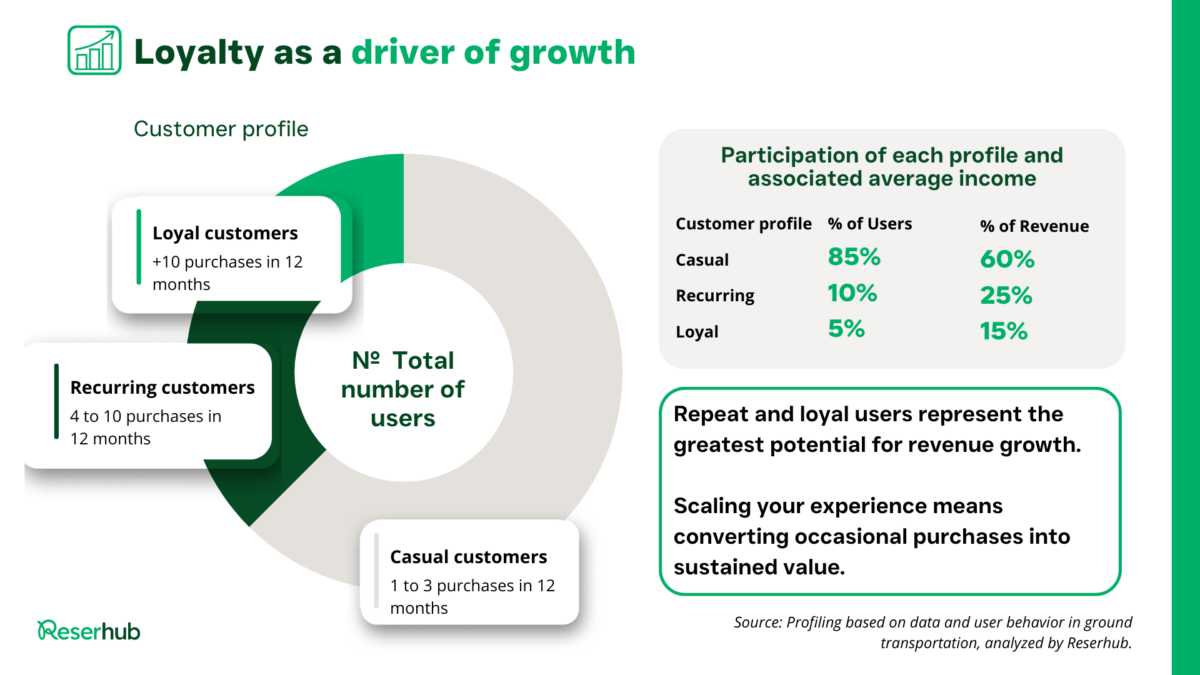
In a recent analysis conducted by Reserhub on digital purchasing behavior, the following distribution of user profiles and revenue impact was identified over 12 months. This pattern demonstrates the growth potential:
85% of users are casual, with 1 to 3 purchases per year, generating 60% of revenue.
10% are repeat users, with 4 to 10 purchases per year, representing 25% of revenue.
5% are loyal users, with more than 10 purchases per year, accounting for 15% of revenue.
Repeat and loyal users generate a larger proportion of total revenue. This means sustainable growth does not come from increasing user volume, but from increasing purchase frequency.
Insight: sustainable growth does not depend on volume, but on user evolution. Action: design data-driven loyalty initiatives to increase purchase frequency and expand traveler lifetime value.
Without a loyalty strategy, every sale starts from zero. This creates three main risks:
Greater dependence on external channels
Higher acquisition costs
Less control over the customer relationship
Conversely, bus companies that strengthen their direct channel and build loyalty strategies can grow more efficiently and sustainably.
The problem: most users do not return
The biggest challenge is not acquisition, but recurrence. Every casual user represents a latent opportunity. They have already trusted the brand, already purchased, and crossed the most difficult barrier: the first conversion.
But if they do not return, acquisition costs are diluted, and growth potential is lost. True impact occurs when that user:
Purchases again
Increases frequency
Develops a relationship with the brand
Loyalty means designing experiences that invite users back
Leading companies do not wait for loyalty to happen; they design it. They build digital ecosystems that accompany users throughout their entire lifecycle, from the first purchase to repeat purchases.
1. Strengthen the direct channel The direct channel is where the relationship happens. It allows companies to understand user behavior and create personalized experiences. Every interaction is an opportunity to drive recurrence.
2. Use data to identify repurchase opportunities Behavior reveals intent. Knowing who purchased, when, and where enables relevant triggers at the right time. Effective loyalty is timely, not generic.
3. Reduce friction in repurchase Convenience drives recurrence. Fast, personalized, and consistent experiences increase the likelihood of return.
Every second of friction is a lost opportunity.
4. Create incentives aligned with real user behavior It is not about offering more benefits, but the right benefits at the right time.
Relevance is the true engine of loyalty.
Loyalty is the bridge between acquisition and sustainable growth. It is not only about selling a ticket, but about building a relationship that strengthens over time.
When a company manages to convert its casual users into repeat and loyal travelers, it not only increases its revenue but also strengthens the predictability of the business and consolidates a lasting competitive advantage.
That's why leading transportation companies are investing in strengthening their direct channels, activating loyalty strategies driven by insights and data, and designing user-centric experiences.
Because in the end, scaling the experience of loyal users means scaling the business.
Pix, Dimo, Yape, and Bre-B are transforming digital payments in Latin America. Discover what this means for ground transportation and how to sell more with less friction.
The way people complete a payment process is changing faster than ever in Latin America. Today, millions of users no longer think in terms of cards, cash, or slow, friction-filled transfers. They expect to pay in seconds, from their mobile phones, using simple, secure solutions available 24/7.
Digital payments are any type of cashless transactions made without physical currency, in both online and offline settings. This includes card payments (debit, credit, and prepaid), digital wallets, digital bank transfers, instant digital payments, QR code payments, or payments via payment links.
However, instant transfer systems are redefining the payment experience across the region by addressing key barriers and improving the digital payment process. Examples of this type of payment include Pix in Brazil, Dimo in Mexico, Yape in Peru, and Bre-B in Colombia.
For ground passenger transportation, this transformation is not a distant or unrelated trend, but a concrete opportunity to improve conversion, reduce friction, and accelerate direct sales.
At Reserhub, we are clear that integrating multiple digital payment methods is no longer an operational detail; it has become a strategic decision and a competitive advantage. Today, in e-commerce, payment does not close the funnel: it defines it. This is where loyalty is earned, or the user is lost.
Digital payments in Latin America: a regional perspective
Latin America has a unique characteristic: high levels of cash usage, combined with rapid adoption of digital solutions when they solve real friction. Currently, digital and electronic payment methods represent 60% of total consumer spending, according to PCMI Insights data.
Instant payments emerged precisely to close the gap between financial inclusion, speed, and user experience.
As a region, we have been making progress in digitizing payments. In Mexico, a success case is SPEI. Its use is increasingly common for person-to-person payments or high-ticket transactions. We enable it, for example, in Mercado Pago as a payment method, but we are still far from what is happening in Brazil or what is about to happen in Colombia with Bre-B. In Mexico, there are initiatives such as Dimo.— Jorge Cabrera, Commercial Director of Mercado Pago Mexico.
Jorge shared that one of the biggest challenges is getting more people to digitize their money. The question is not whether the tools work, which has already been proven, but what happens when users do not have a savings account that allows them to use them. For example, with Pix in Brazil, users must have a bank account to transfer money.
We understand the pain very well. When speaking with companies, the pattern repeats itself: investing in acquiring a digital customer, bringing them almost to the end of the process, and then the transaction fails at the last step because the user does not have a card, or must leave home to pay in cash at a store. That is where the impact is greatest. The most critical point in the funnel is payment, when all the operational, commercial, and marketing effort has already been made, and the sale is lost at the final stage. — Jorge Cabrera, Commercial Director of Mercado Pago Mexico.
What Are Pix, Dimo, Yape, and Bre-B?
Pix (Brazil)
Pix is an instant payment system created and managed by the Central Bank of Brazil (Banco Central do Brasil, BCB) that enables real-time transfers and payments, 24 hours a day, every day of the year, with immediate settlement. It was launched in November 2020 as part of a public policy to promote financial inclusion and modernize the country’s payment system.
Pix enables payments and transfers between individuals, businesses, and merchants directly from a bank account using simple keys such as a phone number, email address, tax ID number, or a random code, without the need for complex banking details. It also supports QR code payments, facilitating its use at both physical and digital points of sale.
Since its introduction, Pix has seen massive adoption in Brazil. As of September 2025, in a country with a total population of 213 million people, 170.2 million Brazilians had already used Pix, according to data published by the Central Bank of Brazil.
During 2025, an average of more than six million transactions were processed per month.
Dimo (Mexico)
Banco de México (Banxico) has sought to implement initiatives similar to Pix in Brazil to promote financial inclusion. In March 2023, it launched a new real-time instant payment system: Dinero Móvil, or Dimo.
For person-to-person transfers, Dimo allows users to send and receive money using only the mobile phone numbers of the sender and recipient, as long as both are registered in the system.
This system is the successor to CoDi (Cobro Digital), launched in 2019, which prioritizes QR codes and enables payments via QR and NFC technology, eliminating the need for physical cards. Although the number of accounts that have made at least one payment using this method remains relatively low.
In the case of Dimo, the number of registered users grew from 5.6 million in January 2024 to 12.2 million by December of the same year. Meanwhile, for CoDi, by December 2024, the average number of daily transactions reached 9,903, according to Banxico data.
Mexico is progressing at a more gradual pace. While SPEI continues to grow steadily, Dimo still faces challenges in achieving mass adoption, mainly due to low levels of banking penetration (only around 52% of adults have a bank account). Even so, it represents a key foundation for the future of instant payments.
Bre-B (Colombia)
Bre-B is the interoperable instant payment system of the Bank of the Republic of Colombia, through which all Colombians can transfer money regardless of their financial institution.
To complete a transaction, users simply need to access the Bre-B button within their financial institution’s app, enter the recipient’s key, and specify the amount to transfer.
To receive payments, users must have at least one key registered, which may be a phone number, national ID number, email address, or an alphanumeric code assigned by the financial institution. All keys can be viewed and managed directly from the same Bre-B button within the app.
Since its launch and operational rollout, millions of transactions have been processed through Bre-B. As of January 15, 2026, more than 33 million clients were registered, and over 312 million transactions had been completed, according to data published by the Bank of the Republic.
Colombia is still in an early stage, but with a clear regulatory framework and direct learnings from cases like Pix. All signs point to accelerated adoption once the system is fully operational.
Yape (Peru)
Yape is a private wallet created by Banco de Crédito del Perú (BCP) that allows users to send and receive money instantly using only a mobile phone number or QR code, with no transfer fees between app users. It also enables bill payments, mobile top-ups, and more.
Currently, Yape has more than 15 million active users, and by 2026, it expects to reach 16.5 million active users.
What does instant digital payment mean for ground transportation?
In ground transportation, payment is often the point of greatest friction in the sales funnel. The user has already chosen the route, schedule, and seat, but abandons the process when:
They do not have a card
The process is slow
They must leave to pay in cash
The system fails or is slow to confirm
There are limited payment options
Digital payments directly address these issues. For high-frequency routes, short trips, or last-minute purchases, being able to pay in seconds can be the difference between completing a sale and losing the passenger.
Wallets and instant transfers: their role in the purchase journey
Digital wallets are applications or platforms that allow users to store money electronically, save payment methods, and perform transactions quickly and securely from a mobile device or the web. They facilitate payments, transfers, and purchases without the need for cash or physical cards, and typically integrate security layers such as biometric authentication and encryption.
For this reason, wallets and instant payments are not just another payment method; they are conversion and loyalty accelerators.
Within the digital funnel, they:
Reduce the time between intent and purchase
Eliminate unnecessary steps
Decrease checkout abandonment
Enable spontaneous and opportunistic purchases
For example, when users already have money in a wallet, payment becomes almost invisible, significantly increasing transaction success rates.
What does a bus company need to integrate them successfully?
Adding instant payments is not just about “adding a button.” It requires internal alignment between product and development teams to enable seamless integration of multiple digital payment methods within the e-commerce experience. Working with a technological partner such as Reserhub helps accelerate this process and provides the expertise needed to achieve it efficiently and effectively.
Based on Reserhub’s experience, companies require:
Flexible payment infrastructure Capable of integrating multiple methods (wallets, transfers, cards) without friction or isolated developments.
Intelligent payment orchestration Selecting the best method by country, context, average ticket size, fees, and traveler behavior.
Unified data visibility Understanding which payment methods convert best, across routes, schedules, and passenger profiles.
A specialized technology partner With deep industry knowledge, regulatory foresight, and the ability to accelerate integration without disrupting daily operations.
The role of a strategic technology partner
The region is moving toward a scenario in which instant payments will be the standard, not the exception. For transportation companies, the challenge goes beyond simply adapting—it requires doing so with speed, control, and a long-term vision.
At Reserhub, we work to ensure that payment technology becomes a growth enabler for our partners’ direct sales channels, not an obstacle. We integrate payment ecosystems designed for the realities of Latin America, connected to data, revenue, and passenger experience.
Because the future of ground transportation is about understanding the traveler and turning every interaction into real value for the sector.
Pix, Dimo, Yape, and Bre-B are not isolated cases. They are clear signals of where the region is headed. Transportation companies that prepare today will be better positioned to capture tomorrow’s demand.
The question is no longer whether digital payments will reach ground passenger transportation operations, but how ready companies are to take advantage of them when they do.
At Reserhub, we support bus companies on that journey, connecting technology, data, and payments to drive a more agile, profitable, and traveler-centric direct sales channel.
Discover Reserhub's insights at Busworld 2025 and how digitization, data, and omnichannel are transforming the future of ground transportation.
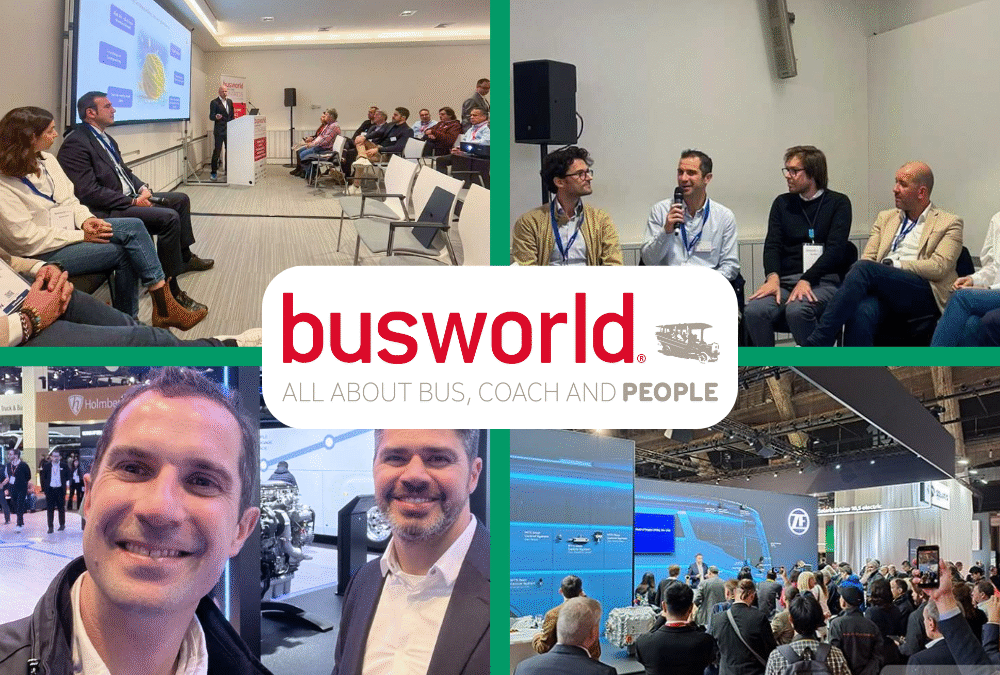
In a context where collective mobility faces new challenges and opportunities, Busworld Europe 2025 emerged as a key meeting point for the future of passenger ground transportation.
Throughout the event, leaders, operators, and experts aligned around a shared vision: digital transformation is no longer a trend, but a strategic necessity for growth and better connecting with travelers.
Reserhub actively contributed to this conversation, represented by Sebastián Gómez, President of the company, who participated in the panel “Models and Platforms for Collaboration Between Coach Operators, OTAs & Other Stakeholders to Increase Ridership.” This panel, dedicated to discussing new collaboration models to stimulate demand and strengthen the industry, was a key space for discussion.
A meeting point to understand where collective mobility is heading globally, and how technology can make it more human and more efficient. — Sebastián Gómez, President of Reserhub.
Different digital challenges, one shared goal
One of the most valuable insights Reserhub brings from Busworld is that each region progresses at its own pace and faces unique challenges. In Europe, the main focus is on increasing visibility and controlling distribution in an environment where OTAs and aggregator platforms dominate much of the market. Competition with other modes of transportation, such as rail and air, also requires bus operators to maintain high levels of competitiveness to stand out. European operators aspire to play a central role in shaping the unified digital market.
In Latin America, on the other hand, the challenge lies in digitizing operations and empowering teams. Companies seek tools that allow them to autonomously manage inventory, pricing, and the traveler experience, without depending on intermediaries and while strengthening their relationship with passengers across all channels.
Digital evolution doesn’t start with technology; it starts with people. — Sebastián Gómez, President of Reserhub.
Real change happens when teams take ownership of the digital process, use data to make decisions, and become the driving force of transformation.
Reserhub’s vision: technology that empowers bus operators
During his participation, Sebastián shared the vision that guides Reserhub: a vertical SaaS built specifically for bus companies, designed to strengthen their direct sales channels and reinforce their independence from OTAs and other digital distribution models.
Reserhub’s technology ecosystem is designed to meet the real needs of the industry, with faster purchase flows, route-based inventory logic, advanced segmentation, dynamic pricing, and integrated tools to optimize operations and personalize the traveler’s digital experience, all from a single platform.
Reserhub acts as a strategic partner for ground transportation companies, driving their growth and digital autonomy. The company is driven by the belief that data is the fuel of the next generation of bus operators and that maintaining control over customer relationships and information is essential to building a sustainable business.
Personalization and omnichannel experiences: the new traveler standards
One of the topics addressed by Sebastián in the Busworld panel was personalization as a key driver of growth. Just as digital entertainment platforms like Netflix recommend tailored content to each user, bus companies can use behavioral data to offer personalized routes, schedules, and prices that improve conversion and traveler loyalty.
In a market full of options and short attention spans, personalization is no longer a luxury it’s a basic expectation.— Sebastián Gómez, President of Reserhub
Omnichannel experiences also took center stage. Passengers expect to purchase, modify, or access their tickets seamlessly, from any device or point of contact.
Reserhub supports this vision through solutions that integrate web, mobile, ticket office, and partner channels, enabling companies to maintain control of their direct channel, customer relationships, and data.
Omnichannel doesn’t mean losing control; it means meeting passengers wherever they are.— Sebastián Gómez, President of Reserhub
Competition requires new capabilities
Competition for passengers now extends far beyond other bus companies. Personal vehicles, trains, mobility-as-a-service operators, and low-cost flights exert constant pressure on the sector. To remain competitive, ground transportation companies must incorporate revenue management, dynamic pricing, and data analytics capabilities traditionally exclusive to the airline industry.
Inspiration comes from everyday digital experiences that have become user expectations: Amazon’s one-click checkout, Uber’s instant confirmation, or airline-style fare management. Travelers expect the same fluidity when purchasing a bus ticket, and Reserhub is committed to making that possible.
Looking ahead
Reserhub’s participation in Busworld 2025 reaffirmed a conviction: the future of collective transportation depends on repositioning it as an efficient, sustainable, and deeply human mobility option.
In the coming years, we will see greater adoption of direct sales strategies, increasingly personalized experiences, more advanced revenue management, and closer collaboration between operators, OTAs, and other key stakeholders.
But above all, we will see a transformation driven by people: by the teams enhancing the digital experience, the travelers who trust collective mobility, and the companies committed to innovation.
At Reserhub, we will continue supporting bus operators in their digital journey, with specialized technology, intelligent data, and a constant commitment to evolving how travel experiences are sold, managed, and delivered across this essential global industry.
Build loyalty and boost sales with a strategic loyalty program. Data, rewards, and examples such as Doters show their measurable impact.
The companies that are truly growing are those that build long-term relationships with their users, strengthen their channels, and leverage technology to personalize every touchpoint.
And there is one strategy capable of achieving this lasting connection: a well-designed loyalty program, built to offer a unique experience within the direct channel. Contrary to what some may think, loyalty programs are not just for accumulating and redeeming points, nor are they limited to physical cards or generic discounts; today, they are digital ecosystems that connect data to develop strategies that help gain relevance through purchasing experiences and personalized rewards for each user.
Bus companies that rely solely on ticket sales—without data analysis or loyalty strategies—risk losing control over their direct channels and becoming increasingly dependent on intermediaries. A well-executed loyalty program can change everything. It allows for better connection with passengers, strengthens the direct channel, and increases sustained revenue over time.
All service providers must deliver impeccable service; it is difficult to generate loyalty if the passenger has a bad experience. But after meeting that standard, the challenge is to stand out. – Pablo Sordo, Chief Loyalty Officer at Viva and Doters.
According to Bond Brand Loyalty, 79% of consumers say they are more likely to buy from brands that offer personalized experiences.
Airlines have been pioneers in using loyalty programs as engines for revenue and retention. For example, in 2022, Delta reported over $7 billion in revenue tied to its SkyMiles program, including direct flight sales and credit card partnerships. Meanwhile, United Airlines, with its MileagePlus program, has stated that member passengers spend up to twice as much as non-registered passengers.
It is necessary to design benefits that truly matter to passengers (preferred seating, discounts for frequent travel, upgrades). It is not about giving everything to everyone, but about offering the right benefits to each individual.
A passenger who feels rewarded and recognized is more likely to:
Purchase through the brand’s app or website.
Travel more frequently.
Recommend the service.
Choose ancillaries or upgrades (such as selecting a seat or purchasing extra luggage).
The impact of loyalty programs on consumer spending in Latin America varies by age, but overall, 82% of respondents say these programs influence their spending level, either “to some extent” (62%) or “to a great extent” (20%).
Loyalty is the result of a company’s consistent effort to go beyond day-to-day service and create a genuine connection: generating attachment, affinity, and the real desire to choose them again. – Pablo Sordo, Chief Loyalty Officer at Viva and Doters.
Simplicity is what converts
A common mistake is designing programs so complex that passengers do not know how to use them. Users must quickly feel the value of their loyalty. Pablo shares that at Doters, they aim to make earning and redeeming points as easy as two clicks.
The digital experience must be smooth, immediate, and frictionless—something that requires strong technological development. Pablo believes technology is essential to simplifying and delivering rewards without complications.
McKinsey estimates that 65% of users abandon a loyalty program due to complex redemption processes.
Understanding how consumers enroll in loyalty programs is essential for optimizing digital channels and improving the experience from the very first contact. In Latin America, digital channels lead sign-ups: 30% of users register through the brand’s mobile app, and 29% via its website, according to the study Estrategias y programas de fidelización en América Latina 2025, conducted by EY consulting.
The data shows that younger consumers (18–24 years old) have a strong preference for mobile registration (33%), while those aged 65 and older rely more on automatic enrollment by the brand (32%) or in-store counters (25%).
This confirms a clear trend: most consumers value fast, accessible, and online registration processes.
How to measure the effectiveness of a loyalty program
In a context where almost every brand offers some reward, measuring effectiveness becomes key to standing out and optimizing resources.
The most important metric in a loyalty program is activity—that is, how many users are earning or redeeming points. This metric, known as the activity rate, serves as the main indicator to determine whether the program is not only in place but is being actively used and generating engagement.
We may have a huge base of registered customers, but if they are not interacting with the program, they are not adding value or helping to build loyalty. What truly moves the needle is active participation.– Pablo Sordo, Chief Loyalty Officer at Viva and Doters.
In addition to the activity rate, other key metrics include:
Frequency of direct channel use after enrollment.
Reward redemption rate: the percentage of points earned that turn into real benefits.
Average time to first redemption, which indicates whether users are seeing value quickly.
Average ticket value among loyal vs. non-loyal users.
According to EY, 61% of consumers are enrolled in programs from two or more brands within the same category, proving that loyalty is not exclusive and that they seek the best available offers.
To stand out in a competitive environment, companies must differentiate their benefits, although many have yet to adapt their programs to achieve this.
For example, Doters is the loyalty program of Viva, one of the most relevant low-cost airlines in Latin America, as well as other Grupo IAMSA brands such as ETN Turistar, Costa Line, Autovías La Línea, along with strategic partners like Primera Plus and roll&bits.
Its impact is measurable and significant: it has more than 10 million active members and a network of over 15 strategic partners, including banks, bus companies, and car rental agencies. User activity levels surpass industry standards, and more than 50% of Viva passengers are already part of the program.
Additionally, Doters members fly approximately 50% more than average, while HSBC Viva users fly 150% more on average. This is a clear example of how a well-designed loyalty strategy can generate real and sustained value.
Direct channel data: a valuable asset for loyalty programs
When bus passengers purchase through intermediaries, key information is lost about who they are, which routes they prefer, and how often they travel.
A loyalty program allows companies to centralize behavioral data to personalize offers and anticipate needs. It also encourages passengers to purchase directly through the company’s digital channels, such as its website or app, avoiding third-party commissions and improving margins.
If I know a passenger dislikes traveling in a window seat, I won't offer them one. Personalization is key to building trust.– Pablo Sordo, Chief Loyalty Officer at Viva and Doters.
Consumers in Latin America consider personalization a fundamental factor in their loyalty program. Effective personalization not only fosters loyalty but also enables a deeper relationship with consumers, according to the EY study.
50% of consumers consider it “very important” to be able to choose their rewards.
Loyalty is neither automatic nor built with generic discounts. It is a strategy to connect emotionally with the passenger, get to know them better, and strengthen the direct channel.
Loyalty is built step by step, with clear incentives, simplicity, and personalization. If your program feels like “just another points card,” the passenger will not return. If it delivers real value, the passenger will choose you again and again. – Pablo Sordo, Chief Loyalty Officer at Viva and Doters.
In an environment where passengers constantly compare options and benefits, loyalty is not won with empty promises, but with relevant, simple, and personalized experiences. For the bus sector, this represents a major opportunity: turning each trip into a long-term relationship.
A well-designed loyalty program not only drives repeat purchases and strengthens the direct channel but it also enables informed decision-making with data-driven insights. The next step is to build a loyalty program that truly makes a difference.
Companies using Reserhub Commerce technology leverage their users’ data and behavior from their direct sales channels to create or strengthen their loyalty programs. These programs are fueled by every interaction and insight, offering personalized and close shopping experiences. When the passenger is at the center, results follow naturally.
Duolingo has revolutionized the connection between brands and users. In this blog post, we explore how its lessons can inspire bus companies to enhance their marketing, personalize the passenger experience, and foster genuine relationships with their customers.
Modern marketing is no longer just about “selling more”; it’s about building genuine relationships with people. A prime example is Duolingo, one of the world’s most beloved language learning apps, which has reshaped the way brands connect with their audiences.
But what does this have to do with ground transportation? Much more than it may seem.
At first glance, a language-learning app and a bus company may appear to belong to entirely different industries. Yet both share a key challenge: connecting with people and accompanying them on their journeys.
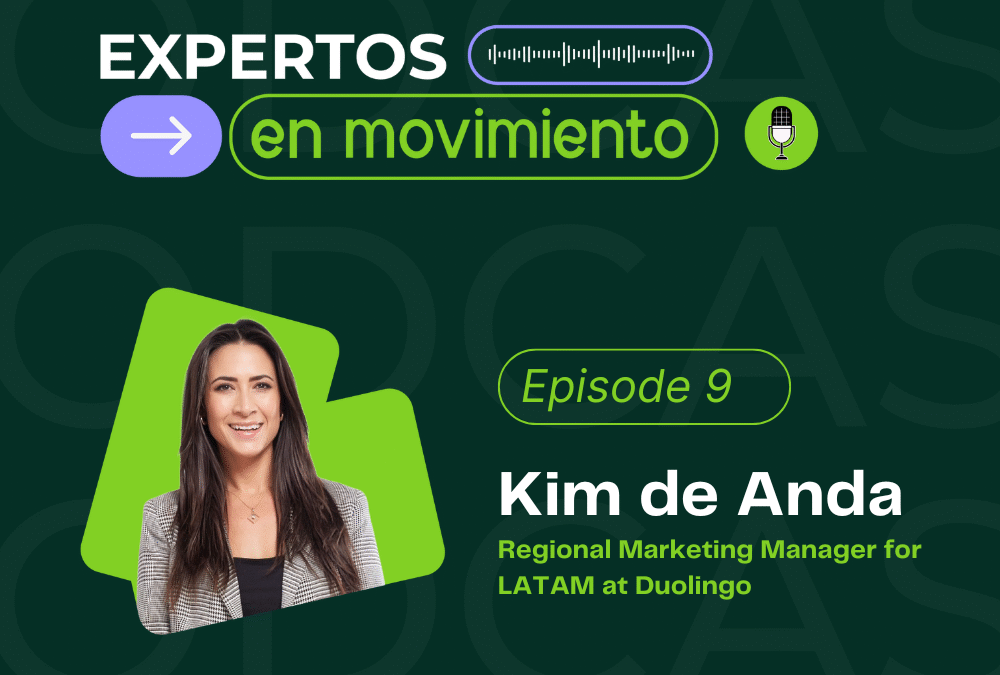
In a recent interview with Reserhub, Kim de Anda, Regional Marketing Director for Latam at Duolingo, shared valuable lessons that can be adapted by bus operators aiming to transform and enhance their passengers’ experience digitally. Here's how:
1. A brief starts by listening to users
At Duolingo, the team often says, “The brief is in the comments.” The best source of inspiration comes from listening to what people are already saying. That’s how they identified the need for a Korean course for Spanish speakers, driven by the rise of K-pop and Korean dramas. They listened, reacted, and launched.
What does this mean for the bus industry?
People are already talking: about what they’d like to improve, what frustrates them about the booking or boarding process, or what they value in their travel experience. If a bus company can identify these signals promptly, it can adapt its service, routes, schedules, communications, and even its app to meet real needs.
2. Don’t speak to everyone at once
One of the most common mistakes is trying to deliver the same message to all audiences. Duolingo learned this the hard way: when they used generic messaging, it failed to connect. But when they tailored tone, formats, and channels to each audience (e.g., TikTok for Gen Z, Facebook for older generations), the impact increased significantly.
How does this apply to ground transportation?
The motivations of a frequent business traveler differ from those of a college student returning home for the weekend. Tailoring messages by audience and by channel (website, app, WhatsApp, social media) is key to making meaningful connections.
What’s truly worked for us is personalizing both the message and the campaign based on the specific audience we’re speaking to. We understand that motivations, generations, and behaviors vary, so we dedicate time to understanding who we’re talking to before we speak. – Kim de Anda, Regional Marketing Director for Latam at Duolingo.
Personalized marketing is not a luxury; it’s essential. 80% of consumers prefer brands that offer personalized experiences. Personalization can also increase sales by 19–20% and reduce acquisition costs by up to 50%, according to Worldmetrics.
This proves that listening, segmenting, and tailoring messages to each audience directly improves performance.
3. Marketing doesn’t end at conversion
Duolingo doesn’t use social media just to drive downloads. They understand that convincing someone to learn a new language takes more than an ad. Instead, their strategy focuses on being part of what matters to people: conversations, fandoms, and memes.
The same logic applies to ground transportation.
Not everyone is ready to travel all the time. But if a brand remains relevant, entertaining, and helpful, it will be top-of-mind when the time to book a ticket arrives.
4. Measure and adapt quickly: start small, scale smart
Instead of investing heavily in uncertain campaigns, Duolingo tests small ideas, tracks responses, and scales the ones that work, whether it’s a social media post or a larger activation like their annual mascot parade.
For a bus company, this could mean:
Testing a new app feature with a small user group
Launching a local campaign on a specific route
Running a limited-time WhatsApp promotion before rolling it out on all channels
The key is agile experimentation: measure, take calculated risks, pivot if needed, and try again.
5. Build an app that truly solves problems, not just “exists”
People are increasingly selective about the apps they keep. Just having an app is no longer enough; it must be intuitive, functional, and useful. Duolingo knows this: they invest in usability, personalization, and daily user engagement.
What should a bus ticketing app offer?
A clear solution: fast purchasing, route visibility, travel reminders
An intuitive interface for all ages
A seamless experience with the fewest clicks possible
What matters most is solving a real problem. People who travel several times a week or month value an app that makes their life easier, quickly, clearly, and consistently. If it doesn’t deliver real and frequent value, it won’t stay on their phone.– Kim de Anda, Regional Marketing Director for Latam at Duolingo.
6. Authenticity can’t be imitated; it must be built
Many brands ask how to become “the Duolingo of their industry.” Kim’s answer is clear: Duolingo already exists. What matters is being yourself, with authenticity and purpose.
A bus company can be traditional, approachable, and trustworthy, and still be emotional, human, and memorable. It’s not about mimicking Duolingo’s humor or mascots; it’s about understanding what moves passengers and connecting with that.
There are brands with a more traditional, familiar, or even serious tone that still have the power to listen and connect emotionally. Communication isn't always about selling, it's about building long-term relationships. The goal isn't to replicate another brand’s output, but to understand the strategy behind it.– Kim de Anda, Regional Marketing Director for Latam at Duolingo.
Where to begin?
Marketing is no longer just about selling. It’s about creating emotional bonds, being useful, entertaining, listening, and above all, connecting.
For ground transportation companies, this means moving away from generic communication and toward user-centered experiences, where every message, channel, and technology decision is designed with the passenger in mind.
It’s not about copying Duolingo, it’s about adopting the mindset that led them to success: deep user understanding, agile experimentation, and a commitment to authentic value.
At Reserhub, we support bus companies in this journey. We help them digitize their sales channels, activate data-driven marketing strategies, and create meaningful passenger experiences.
The first step doesn’t require an overnight transformation. It starts by listening, testing something new, and committing to continuous improvement. Because when users are at the center, results follow naturally.