
The most valuable asset for a bus company is not acquiring users, but retaining them.
In bus ticket sales, growth does not depend solely on attracting new users. It depends, above all, on how many return.
Frequent and loyal users account for a significantly larger share of revenue, despite representing a minority of the total user base.
According to Bain & Company, increasing customer retention by just 5% can boost profits by 25% to 95%. This happens because repeat customers purchase more frequently, have greater trust in the brand, and have a significantly lower conversion cost than acquiring new users.
In the ground transportation sector, where many users travel several times per year for work, family, or tourism, loyalty represents one of the greatest strategic opportunities for bus companies.
The strategic power of customer loyalty
In a recent analysis conducted by Reserhub on digital purchasing behavior, the following distribution of user profiles and revenue impact was identified over 12 months. This pattern demonstrates the growth potential:
- 85% of users are casual, with 1 to 3 purchases per year, generating 60% of revenue.
- 10% are repeat users, with 4 to 10 purchases per year, representing 25% of revenue.
- 5% are loyal users, with more than 10 purchases per year, accounting for 15% of revenue.
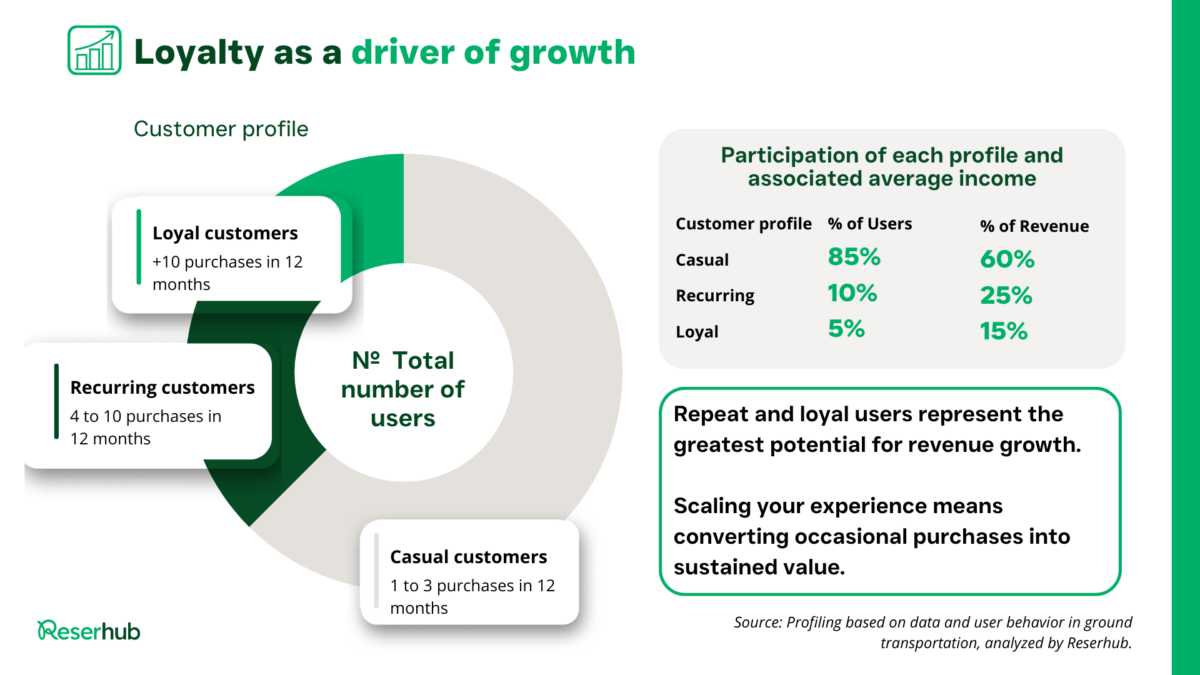
Repeat and loyal users generate a larger proportion of total revenue. This means sustainable growth does not come from increasing user volume, but from increasing purchase frequency.
Insight: sustainable growth does not depend on volume, but on user evolution.
Action: design data-driven loyalty initiatives to increase purchase frequency and expand traveler lifetime value.
Without a loyalty strategy, every sale starts from zero. This creates three main risks:
- Greater dependence on external channels
- Higher acquisition costs
- Less control over the customer relationship
Conversely, bus companies that strengthen their direct channel and build loyalty strategies can grow more efficiently and sustainably.
The problem: most users do not return
The biggest challenge is not acquisition, but recurrence. Every casual user represents a latent opportunity. They have already trusted the brand, already purchased, and crossed the most difficult barrier: the first conversion.
But if they do not return, acquisition costs are diluted, and growth potential is lost. True impact occurs when that user:
- Purchases again
- Increases frequency
- Develops a relationship with the brand
Loyalty means designing experiences that invite users back
Leading companies do not wait for loyalty to happen; they design it. They build digital ecosystems that accompany users throughout their entire lifecycle, from the first purchase to repeat purchases.
Loyalty is not managed as a one-time promotion, but as a continuous strategy to gain relevance, strengthen the customer relationship, and turn every interaction into an opportunity for return. That is why loyalty powers the direct channel through data and personalized rewards.
The most effective actions include:
1. Strengthen the direct channel
The direct channel is where the relationship happens. It allows companies to understand user behavior and create personalized experiences.
Every interaction is an opportunity to drive recurrence.
2. Use data to identify repurchase opportunities
Behavior reveals intent. Knowing who purchased, when, and where enables relevant triggers at the right time.
Effective loyalty is timely, not generic.
3. Reduce friction in repurchase
Convenience drives recurrence. Fast, personalized, and consistent experiences increase the likelihood of return.
Every second of friction is a lost opportunity.
4. Create incentives aligned with real user behavior
It is not about offering more benefits, but the right benefits at the right time.
Relevance is the true engine of loyalty.
Loyalty is the bridge between acquisition and sustainable growth. It is not only about selling a ticket, but about building a relationship that strengthens over time.
When a company manages to convert its casual users into repeat and loyal travelers, it not only increases its revenue but also strengthens the predictability of the business and consolidates a lasting competitive advantage.
That's why leading transportation companies are investing in strengthening their direct channels, activating loyalty strategies driven by insights and data, and designing user-centric experiences.
Because in the end, scaling the experience of loyal users means scaling the business.